

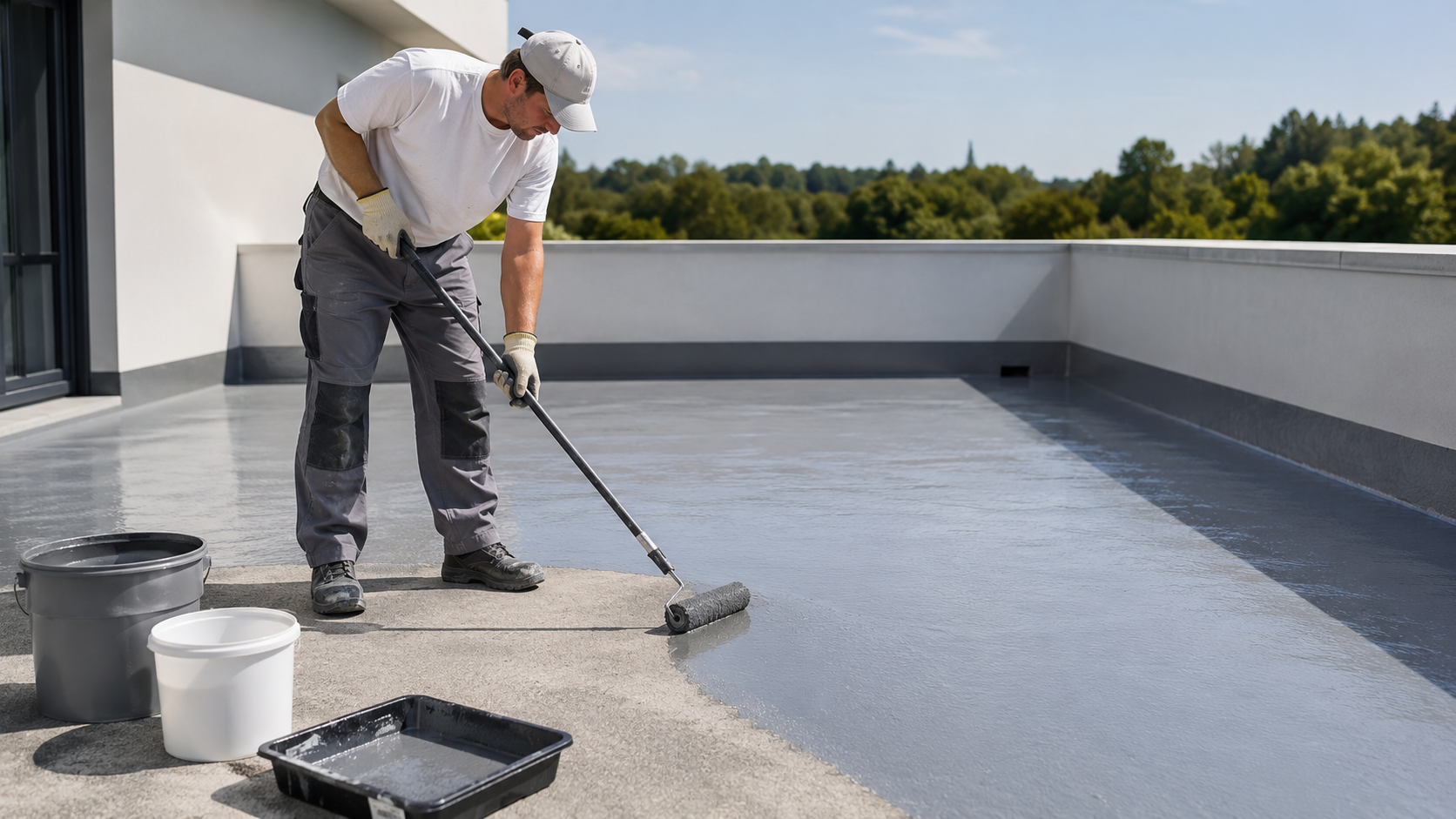
Brush-on waterproofing materials are an effective and common solution for protection against water penetration, dampness, and infrastructure damage. They are applied using a roller, brush, trowel, or spray, and are suitable for roofs, walls, balconies, wet rooms, basements, foundations, and concrete surfaces.
Their main advantage is the ability to create a continuous and flexible waterproofing layer, without seams or joints, even in complex areas such as coves, gutters, drainage openings, pipe penetrations, and cracks. Therefore, they are particularly suitable for situations where working with sheets is difficult or when there is a desire to renew an existing waterproofing system without dismantling the entire infrastructure.
It is important to remember that not every brush-on waterproofing material is suitable for every job. A material suitable for a sun-exposed roof will not necessarily be suitable for a basement, and a material suitable for an exterior wall is not always suitable for standing water. The correct choice should be based on the type of substrate, the level of water exposure, weather conditions, the need for flexibility, and the application method.
Maris 250 - Professional Polyurethane Waterproofing Material for Roofs
Maris 250 is one of the prominent professional solutions in the field of brush-on waterproofing materials for roofs. This is a roofing waterproofing material based on 100% polyurethane, particularly suitable for situations requiring high resistance to standing water, sun, and harsh weather conditions. According to the product page, Maris 250 is suitable for waterproofing concrete roofs, corrugated iron, asbestos, channels, gutters, and concrete and wooden planters.
The main advantage of Maris 250 is its ability to create a flexible, continuous, and strong waterproofing layer, without seams or joints. This is especially important for roofs with transitions, openings, uneven slopes, or problematic areas around drains and gutters. The material is suitable for professional use, and the product page states that the initial drying time is about 3 hours, the waiting time between coats is about 6 hours, and the final drying time is about 24 hours.
Maris 250 is particularly suitable for those looking for an advanced waterproofing solution for an exposed roof, a roof with standing water, drainage channels, or surfaces requiring high durability over time. To achieve a good result, it is important to apply it on a clean and dry substrate, use an appropriate primer if necessary, and incorporate reinforcing fabric in sensitive areas such as coves, openings, and gutters.
Aqua Protect - Wet-Application Waterproofing Material for Challenging Cases
Aqua Protect is an advanced waterproofing material especially suitable for situations where ideal conditions are not possible. According to the product page, it is a wet-application waterproofing material, also intended for roofing, which can be applied to wet surfaces and even in pouring rain, is resistant to standing water, resistant to sun and harsh weather conditions, and does not drip or run.
The significant advantage of Aqua Protect is its operational flexibility. In many waterproofing jobs, especially when a leak appears in the rainy season or when the surface does not dry completely, it is difficult to use materials that require a completely dry substrate. In such cases, a material designed for application on a wet surface can provide a particularly important solution.
Ensure that surfaces are free of dust and loose particles, and the material can be applied with a brush, roller, or trowel. In addition, reinforcing fabric can be incorporated between layers if necessary, and for fresh tar, it is recommended to apply an epoxy primer before application.
Aqua Protect is particularly suitable for urgent waterproofing repairs, wet roofs, areas exposed to rain, surfaces requiring high flexibility, and situations where a non-drip or non-running material is needed. It is a solution worth knowing about when looking for a brush-on waterproofing material that handles challenging field conditions better.
Monoflex Nano - New Generation Flexible Elastomeric Waterproofing
Monoflex Nano is an advanced water-based hybrid waterproofing material, designed for waterproofing roofs, walls, and various surfaces. The material creates a flexible, continuous, and seamless waterproofing layer, and is particularly suitable for surfaces exposed to sun, rain, and weather changes. One of its main advantages is the ability to apply it even on existing waterproofing substrates, including bituminous membranes and old tar, subject to proper surface preparation and thorough cleaning of the surface.
Monoflex Nano adheres well to a variety of substrates such as concrete, cement, wood, metal, and existing waterproofing surfaces, making it suitable for renewing existing waterproofing without the need for complete removal of the old layer. Before application, it is important to ensure that the surface is clean, stable, dry, and free of loose particles, and in sensitive areas, it is recommended to incorporate reinforcing fabric or pre-treatment as needed. Due to being a water-based material, it is easy to work with and especially suitable for those looking for a flexible, advanced, and more user-friendly waterproofing solution.
The main characteristic of Monoflex Nano is its flexibility. An elastomeric waterproofing material copes better with slight movements of the substrate, temperature changes, and contraction and expansion of the surface. Therefore, it is particularly suitable for roofs and exposed surfaces where a flexible, continuous, and easy-to-apply waterproofing layer is required.
Monoflex Nano bridges most cracks up to 2 mm; wider cracks should be sealed with an appropriate sealing mastic. It can be applied with a brush or roller, usually in two coats, with the second coat applied perpendicular to the first after it has fully dried. If necessary, a third coat can be added and reinforcing fabric incorporated to strengthen the waterproofing.
Monoflex Nano is suitable for those looking for a convenient, flexible, and seamless brush-on waterproofing material, especially for roofs, concrete surfaces, wood, and metal. It can also be suitable for renewing existing waterproofing, subject to professional assessment of the substrate and decision on whether a primer is needed.
Bitupast - Bituminous Paste Waterproofing Material for Concrete, Foundations, and Bituminous Surfaces
Bitupast is a bituminous paste waterproofing material, designed for waterproofing and protecting various surfaces. According to the product page, it is a bituminous paste waterproofing emulsion against water, containing synthetic resins and mineral stabilizers, with good adhesion to building materials and no solvents. It is suitable for polyurethane, polystyrene, concrete, metal, and wood, among others.
The material is suitable for waterproofing and protecting horizontal and vertical concrete surfaces, including ceilings, floors, exterior walls, foundations, and bridge bases. Additionally, it is suitable for maintaining old, waterproof bituminous surfaces.
The main advantage of Bitupast is its suitability for bituminous waterproofing jobs where a strong paste layer is required for protection against water and moisture. It is particularly suitable for foundations, exterior walls, concrete surfaces, and areas where a brush-on bituminous solution is needed. According to the instructions for use, it should be applied to a clean surface free of dust, oil, and loose materials, using a brush, roller, or airless spray, and at least two coats should be applied in crossed directions after the first coat has dried.
Bitupast is particularly suitable when a more convenient bituminous material is desired compared to hot tar, and when the work focuses on protecting concrete, foundations, exterior walls, or maintaining existing bituminous infrastructures.
How to choose between the different waterproofing materials?
The correct way to choose a brush-on waterproofing material is not to ask "which material is best," but "which material is most suitable for my problem." Each product has a different advantage:
|
On-site situation
|
Particularly suitable material |
Why? |
|
Exposed roof with high resistance to standing water needed |
Professional polyurethane material, suitable for roofs and standing water |
|
|
Wet roof or surface requiring treatment even in challenging conditions |
Suitable for application on wet surfaces and even in pouring rain according to product page |
|
|
Roof or surface requiring a flexible, seamless coating |
Flexible elastomeric material, suitable for roofs and various substrates |
|
|
Exterior walls, foundations, concrete, or existing bituminous substrate |
Bituminous paste material for protection and waterproofing of concrete and bituminous surfaces |
The right choice will also consider the desired shade, the level of sun exposure, the condition of the substrate, whether there is standing water, the need for reinforcing fabric, the possibility of applying a primer, and the experience of the person performing the work.
Common mistakes in applying brush-on waterproofing materials
One of the most common mistakes is applying waterproofing material to an unprepared surface. Dust, grease, unsuitable moisture, loose particles, and unstable old material can significantly impair the adhesion of the material. Even with a high-quality material, the substrate is the foundation of the work.
Another mistake is applying only one coat when two or more coats are required. Most brush-on waterproofing systems require a certain cumulative thickness to provide real protection. A layer that is too thin may look good on the day of application but may not withstand water load over time.
Skipping reinforcement of sensitive areas is also a common mistake. Coves, corners, gutters, cracks, pipe penetrations, and joints between surfaces are where waterproofing failures typically develop. In such areas, it is recommended to consider using reinforcing fabric or appropriate sealing mastic as part of the waterproofing system.
Another mistake is choosing material based solely on price. A cheap material that is not suitable for the substrate or site conditions can lead to repeated repairs, water penetration, and greater damage in the long run. Waterproofing is an area where professional suitability is more important than the initial product price.
Brush-on waterproofing material for roofs - what to check?
When choosing a brush-on waterproofing material for a roof, it is important to check several key parameters: whether the material is resistant to standing water, whether it is sun-resistant, whether it is suitable for the existing substrate, whether a primer is required, whether it can be applied with a roller or brush, what the recommended number of coats is, and what the coverage per square meter is.
For roofs exposed to the sun, it is generally preferable to choose light-colored materials or materials designed for high resistance to weather conditions. For roofs where water accumulates, ensure that the material is suitable for standing water. For old roofs with tar, membranes, or previous waterproofing layers, it is important to thoroughly check the condition of the substrate and the need for a primer or special preparation.
Brush-on waterproofing material for walls, foundations, and basements
Waterproofing walls, foundations, and basements differs from roof waterproofing. Here, resistance to moisture, water pressure, and soil conditions is highly important. Bituminous materials like Bitupast can be very suitable for protecting concrete surfaces, exterior walls, and foundations, especially when a paste-like waterproofing layer against water and moisture is required.
In underground areas or places with continuous water exposure, it is especially important to ensure that the material is suitable for the nature of the work. Not every roof material is suitable for an underground wall, and not every bituminous material is suitable for an exposed roof without additional protection. Proper matching will prevent failures and extend the life of the waterproofing system.
Are brush-on waterproofing materials suitable for DIY work?
Some brush-on waterproofing materials are also suitable for private users, especially for small jobs, spot repairs, or renewing simple surfaces. However, large jobs such as waterproofing an entire roof, waterproofing a basement, treating standing water, or rehabilitating an old waterproofing system require professional knowledge, proper surface preparation, and full adherence to manufacturer's instructions.
Anyone performing the work themselves must thoroughly read the instructions for use, adhere to weather conditions, drying times, layer thickness, primer use, reinforcing fabric incorporation, and tool cleaning. For complex jobs, it is best to consult before choosing the material to avoid costly mistakes.


